


Page 41 - 2017食品藥物管理署年報(英文版)
P. 41
2017 Taiwan Food and Drug Administration Annual Report             Chapter 3. Source and Manufacturing Management


                     (2) Border inspection
                        Food imports and related products must undergo and pass boarder inspections at
                     harbors, ports and customs before the importation may proceed. Refer to Table 3 in

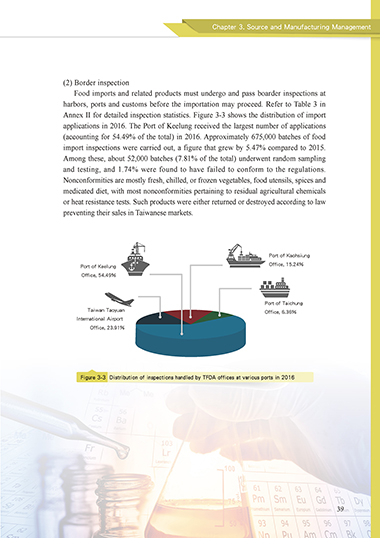
                     Annex II for detailed inspection statistics. Figure 3-3 shows the distribution of import
                     applications in 2016. The Port of Keelung received the largest number of applications
                     (accounting for 54.49% of the total) in 2016. Approximately 675,000 batches of food
                     import inspections were carried out, a figure that grew by 5.47% compared to 2015.
                     Among these, about 52,000 batches (7.81% of the total) underwent random sampling
                     and testing, and 1.74% were found to have failed to conform to the regulations.
                     Nonconformities are mostly fresh, chilled, or frozen vegetables, food utensils, spices and
                     medicated diet, with most nonconformities pertaining to residual agricultural chemicals
                     or heat resistance tests. Such products were either returned or destroyed according to law

                     preventing their sales in Taiwanese markets.


                                                                                     Port of Kaohsiung

                          Port of Keelung                                            Office, 15.24%
                           Office, 54.49%


                                                                                    Port of Taichung
                            Taiwan Taoyuan                                          Office, 6.36%
                         International Airport
                             Office, 23.91%


                          Figure 3-3  Distribution of inspections handled by TFDA offices at various ports in 2016


                                                                                                           39

